The Iron Triangle: Cost, Quality and Time in Construction
Cost, quality and time are the three sides of the iron triangle. Here is what each one means on a construction job, why you cannot maximise all three, and how to choose.

Luke Sanders
IT Developer
Updated 14 July 2026
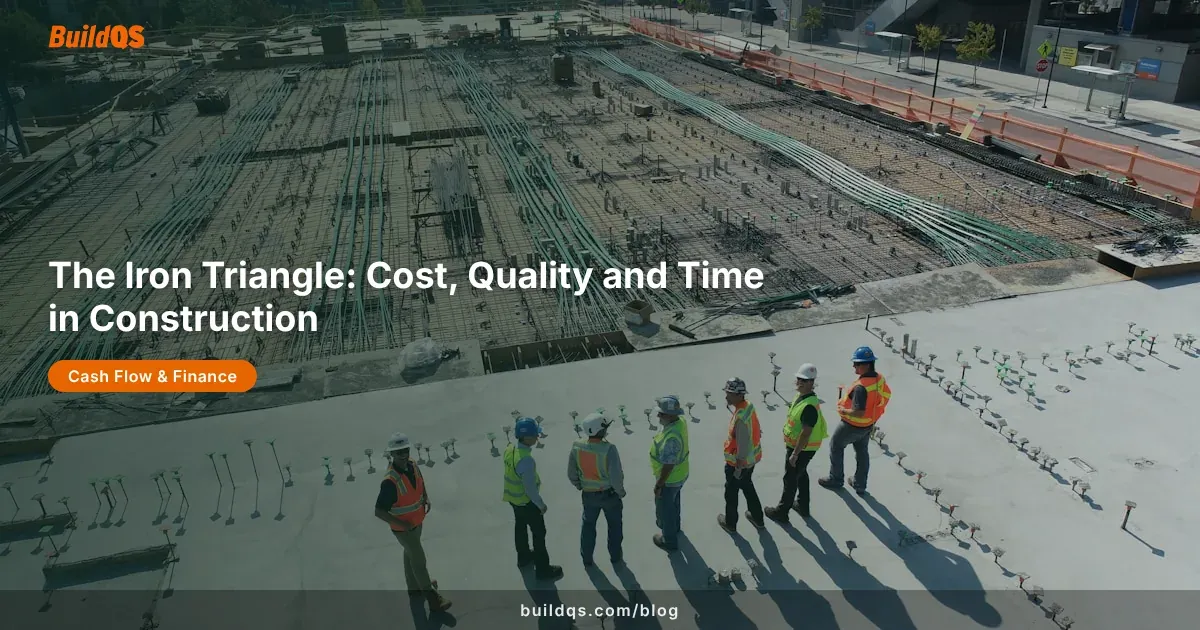
Table of contents
Every construction job is a balancing act between three things: what it costs, how good it is, and how long it takes. Push hard on one and at least one of the other two has to give. Ask for a job finished faster and you usually pay more or accept a rougher finish. Squeeze the budget and you stretch the programme or drop the spec. This is not bad management, it is the basic physics of getting work done.
That trade-off has a name. Project managers call it the iron triangle, the project management triangle, or simply cost, quality and time. Once you can see it on a job, a lot of the arguments you have with clients, main contractors and your own team start to make sense.
This guide explains what the iron triangle is, what each of its three sides means on a real construction project, why you cannot have all three at once, and how to manage the trade-offs deliberately instead of letting them happen to you.
What is the iron triangle?
The iron triangle is a model that says every project is shaped by three competing constraints: cost, quality and time. The three are linked, so you cannot change one without affecting at least one of the others. The classic shorthand is "good, fast, cheap, pick two", because no project realistically delivers all three at their best at the same time.
The idea is usually credited to Dr Martin Barnes, who set out the time, cost and quality relationship in a course he ran in 1969. It has been a cornerstone of project management thinking ever since, and it sits at the heart of how bodies like the Association for Project Management (APM) and the Project Management Institute (PMI) teach people to think about delivery.
Picture an actual triangle. Each side is one constraint. If you stretch one side, the shape of the triangle has to change, which means the other sides move too. You are never adjusting one thing in isolation.
The three constraints, one by one
The three sides of the triangle are cost, time and quality. Each one is a lever you can pull, and each pull has a price somewhere else on the triangle. Here is what each means on a construction job.
Cost
Cost is everything the work consumes to get done: labour, materials, plant, subcontractors, and your share of preliminaries and overhead. On a priced job it also carries your margin. When a client talks about "the budget", this is the side of the triangle they are pointing at.
Cost is the side subcontractors feel most directly, because it is your money at risk until you are paid. Material price rises, an extra week of agency labour, or plant kept on hire longer than planned all push this side outward, and if the value you can recover does not move with it, your margin is what absorbs the difference.
Time
Time is the programme: the start date, the key milestones, and the completion date you have committed to. On construction projects time is rarely just yours to manage, because your works sit inside a main contractor's programme and depend on the trades before you finishing on time.
Time is expensive in ways that are easy to underestimate. Compressing a programme usually means overtime, weekend working, or more operatives on site at once, all of which cost money. Letting a programme slip can trigger delay claims, liquidated damages, or simply hold your cash up for longer while you wait on the next valuation.
Quality
Quality is the standard of the finished work: does it meet the specification, the drawings, the building regulations and the client's expectations? On the triangle, quality is often the quietest side, because unlike cost and time it does not show up as an obvious number until something goes wrong.
Quality is where corners get cut when the other two sides are under pressure, and it is the most expensive place to find a problem late. A defect picked up on a snagging list is cheap to fix. The same defect found after handover, during the defects liability period or once retention is on the line, costs far more and damages the relationship that wins you the next job.
Why you cannot have all three
You cannot maximise cost, time and quality at the same time because they pull against each other. Improve one and you almost always pay for it on another side of the triangle. This is the part of the model that catches people out, because clients and main contractors will often ask for all three and expect you to absorb the conflict.
Work through the common requests and the trade-off is always there:
- "Can you do it cheaper?" Holding the same deadline, a lower price usually means a lower specification, cheaper materials, or less labour, which lands on quality. Or you keep the quality and the programme stretches.
- "Can you do it faster?" Pulling the completion date forward means overtime, more operatives, or accepting a rougher finish. Faster normally costs more, threatens quality, or both.
- "Can you make it better?" Raising the standard takes more time, more skilled labour, or better materials, all of which push cost or time outward.
Many people add a fourth element, scope, in the middle of the triangle. Scope is how much work there is. It is a useful addition, because changing scope is often the cleanest way to rebalance a job. If a client wants it cheaper and faster without dropping quality, the honest answer is usually "then we do less", and that is a scope conversation, not a magic trick. In construction, this is exactly what variations and value engineering are: deliberate, documented changes to scope so the triangle stays balanced.
The triangle on a real construction job
The triangle stops being theory the moment a client changes their mind mid-project. Here are two worked examples, in GBP, showing how a single request ripples across the other two sides.
Example one: the deadline moves forward. You priced a £120,000 fit-out over ten weeks with a two-operative team. In week three the client needs it done in eight weeks to hit a tenant move-in date. Time has been squeezed, so the other sides must move. To recover two weeks you put a third operative on and run two Saturdays, adding roughly £6,000 of extra labour and premium hours. That is the cost side absorbing the change. The alternative, holding cost flat by rushing the same team, risks defects on the finishes, which is the quality side paying instead. Either way, the triangle rebalances, and the only real choice is which side takes the hit.
Example two: the budget gets cut. A client wants the same £120,000 package delivered for £105,000. With quality and the programme fixed, that £15,000 has to come from somewhere. The constructive route is a scope conversation: substitute a specified floor finish for a lower-cost equivalent, or remove an item from the package entirely. That keeps the work you do deliver to standard and on time. The destructive route, quietly trimming labour or materials to hit the number while promising the same outcome, just moves the cost onto the quality side, where it reappears later as snagging, rework and a retention dispute.
In both cases the job that goes well is the one where the trade-off is named out loud, agreed, and written down, ideally as a priced variation. The job that goes wrong is the one where someone pretended the triangle did not exist.
How to manage the trade-offs
You manage the iron triangle by deciding which side matters most before the pressure hits, and then protecting it. You cannot stop the trade-offs happening, but you can choose where they land instead of being surprised by them. A few practical habits make the difference.
- Agree the priority order up front. On every job, know which of cost, time and quality is the client's non-negotiable. A project chasing a fixed opening date is time-led; a tightly funded one is cost-led. Price and plan accordingly.
- Price and document every change. When a request moves one side of the triangle, capture the effect on the others as a written, priced variation before you do the work. This is also your protection under the contract, and ties directly into the payment terms set by the Construction Act.
- Protect the side that matters most. If quality is the priority, do not let a compressed programme erode it. If cost is the priority, resist scope creep that quietly inflates it.
- Keep cost and programme visible together. You cannot manage a trade-off you cannot see. Tracking spend against the programme as the job runs, the same discipline behind a good cash flow forecast, is what turns the triangle from an after-the-fact excuse into a live decision-making tool.
Where tools fit in
Most disputes over cost, quality and time come down to the same root cause: the trade-off was never recorded clearly, so two parties remember it differently. Keeping your valuations, variations and programme in one place, rather than scattered across emails and spreadsheets, means that when a client asks for it cheaper or faster, you can show exactly what that does to the rest of the job.
That is the practical job BuildQS is built for: turning every payment application, variation and retention figure into a clear, shared record, so the conversation about the triangle happens on the facts.
Keep cost, time and scope in one clear record
BuildQS replaces the spreadsheet juggling act with structured payment applications, variations and retention tracking, so the trade-offs on every job are visible and agreed.
Start Free TrialBook a DemoPrefer to walk through your workflow live first? Book a Demo
Frequently asked questions
What are the three sides of the project management triangle?
The three sides are cost, quality and time. Cost is what the work consumes to deliver, including labour, materials and margin. Quality is the standard of the finished work against the specification. Time is the programme and the completion date. The three are linked, so changing one affects the others.
Is scope part of the iron triangle?
Scope is often added to the model, usually drawn in the middle of the triangle, because changing how much work there is is one of the cleanest ways to rebalance cost, quality and time. In construction, variations and value engineering are scope adjustments: deliberate, documented changes that keep the triangle in balance rather than forcing quality or budget to absorb a conflict.
Which constraint should you prioritise on a construction project?
There is no universal answer, because it depends on the client's goal for that specific job. A project tied to a fixed opening or move-in date is time-led; a tightly funded one is cost-led; a high-spec or reputation-critical job is quality-led. The key is to establish the priority before work starts, so that when pressure comes, you protect the right side of the triangle.
How does the iron triangle apply to subcontractors?
For subcontractors the triangle is sharpest because your works sit inside someone else's programme and your margin sits inside someone else's budget. When a main contractor asks for faster or cheaper, the trade-off lands on your cost or quality. Naming that trade-off and capturing it as a priced variation is how you stop absorbing other people's decisions for free.
Sources
- Association for Project Management (APM). What is the iron (or project management) triangle? APM Body of Knowledge.
- Project Management Institute (PMI). A Guide to the Project Management Body of Knowledge (PMBOK Guide) , on competing project constraints.
- Atkinson, R. (1999). "Project management: cost, time and quality, two best guesses and a phenomenon, it's time to accept other success criteria." International Journal of Project Management, 17(6), 337, 342.
- Barnes, M. (1969). Time and cost in contract control , the course in which the time, cost and quality relationship was first set out.